About HydraDB OSS
What is HydraDB OSS?
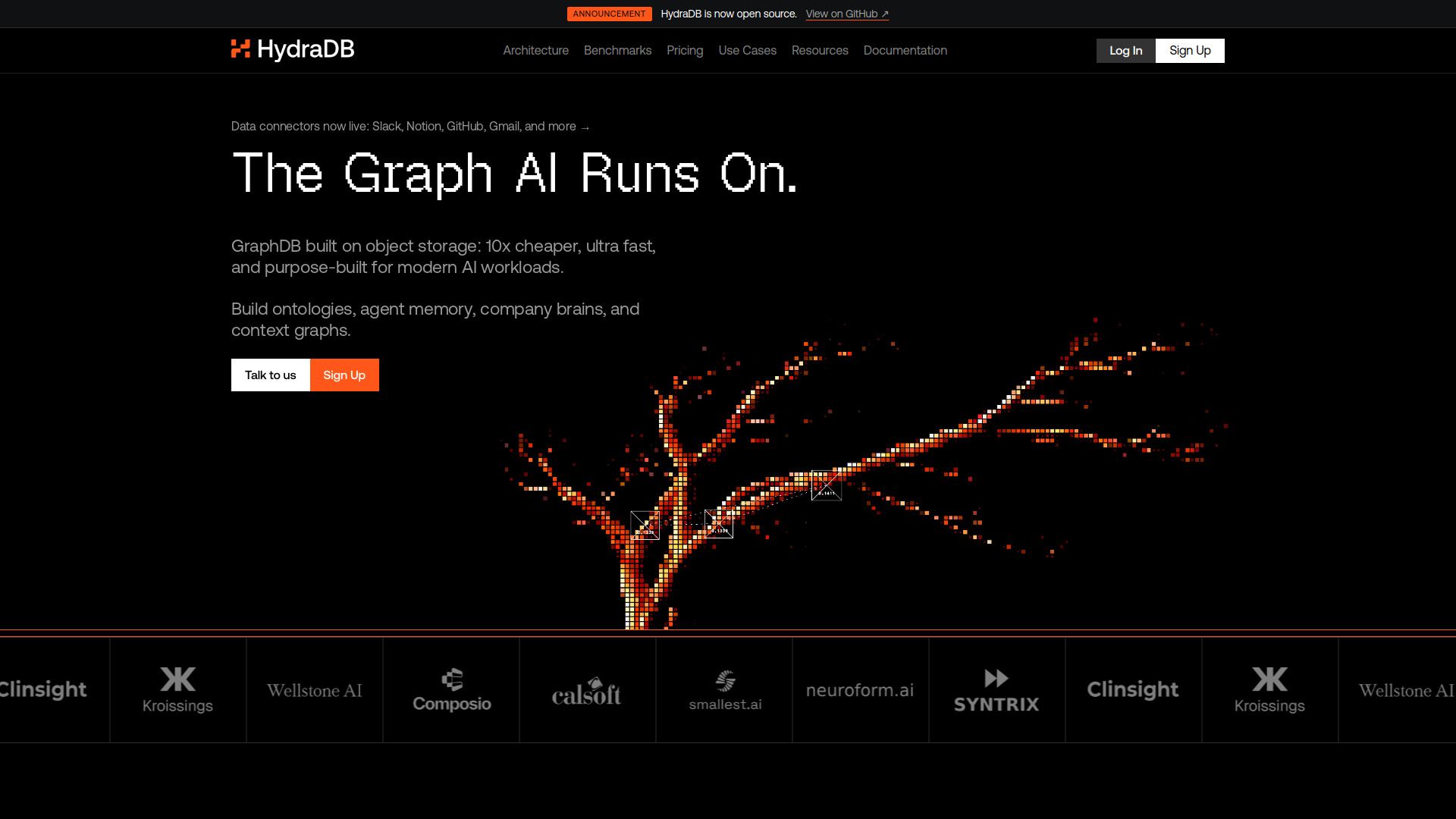
HydraDB is an object-store-native distributed graph database built in Rust, specifically designed to serve as the context layer for AI systems. Unlike traditional graph databases that tie storage closely to database servers or dedicated cluster volumes, HydraDB utilizes object storage as the source of truth. This architecture allows query nodes and indexers to scale, restart, or be replaced independently without the need to move or replicate the graph.
Key features of HydraDB include:
Snapshot-consistent OpenCypher support
GraphBLAS-accelerated traversal
Neo4j-compatible Bolt and HTTP APIs
Cost-effective and ultra-fast performance, being 10x cheaper than traditional solutions
Purpose-built for modern AI workloads, enabling the building of ontologies, agent memory, company brains, and context graphs
HydraDB OSS Features
HydraDB is an object-store-native distributed graph database built in Rust, specifically designed to function as the context layer for AI systems. It distinguishes itself from traditional graph databases by making object storage the source of truth, allowing for greater flexibility in scaling and managing query nodes and indexers. This architecture enables these components to scale, restart, or be replaced independently without the need to move or replicate the graph, enhancing overall efficiency.
Key features and capabilities of HydraDB include:
Snapshot-consistent OpenCypher support
GraphBLAS-accelerated traversal for improved performance
Neo4j-compatible Bolt and HTTP APIs for seamless integration
Enhanced relationship management for AI agents, allowing them to follow explicit connections between various entities
Why HydraDB OSS?
HydraDB OSS offers significant advantages for organizations looking to leverage modern AI workloads. Built on object storage, it is designed to be 10x cheaper and ultra-fast, making it an ideal choice for building ontologies, agent memory, company brains, and context graphs. This cost-effectiveness, combined with its performance, positions HydraDB OSS as a compelling solution for teams aiming to innovate in the AI space.
Some key benefits of using HydraDB OSS include:
Cost efficiency: Significantly lower storage costs compared to traditional databases.
High performance: Optimized for speed, enabling rapid data processing and retrieval.
Flexibility: Supports a variety of data connectors, enhancing integration capabilities.
Open-source model: Provides transparency and community-driven development.
How to Use HydraDB OSS
To get started with HydraDB OSS, you can follow a simple tutorial that guides you through the installation and initial setup. First, ensure you have the necessary prerequisites, such as a compatible version of Rust and access to object storage. Once your environment is ready, you can clone the HydraDB repository from GitHub and follow the instructions in the README file to build and run the database.
After setting up HydraDB, you can explore its features, which include support for snapshot-consistent OpenCypher, GraphBLAS-accelerated traversal, and Neo4j-compatible Bolt and HTTP APIs. These features make it easier to integrate HydraDB into your AI systems and leverage its capabilities for managing complex relationships and states.
Object-store-native architecture for scalable performance
Independent scaling of query nodes and indexers
Support for advanced graph queries and traversals
Ready to see what HydraDB OSS can do for you?and experience the benefits firsthand.
Key Features
How to Use
Visit the Website
Navigate to the tool's official website.
Pros & Cons
What's good
What's not good
Pricing
- 1 GB hosted sandbox
- Basic graph features (open source, hosted)
- 3 connectors
- Queries included
- Data enrichment capped
- Storage $0.50/GB-month on HydraDB Cloud
- Data enrichment $6 per 1M tokens (or bring your own keys)
- Queries included
- All graph capabilities, all connectors
- Automatic tiering across RAM, NVMe SSD & object storage
- Storage $0.25/GB-month on your dedicated deployment
- Dedicated by default, private connectivity
- Custom SLAs (99.9%)
- HIPAA-ready BAA
- Private Slack
- Custom contract; usage above it at published rates
- Bring your own keys: flat fee, up to 90% off inference
- Dedicated Cloud or BYOC (your VPC, your data stays)
- 99.95% SLA, private connectivity included
- HIPAA-ready BAA + customer controls