
Scalebrowser
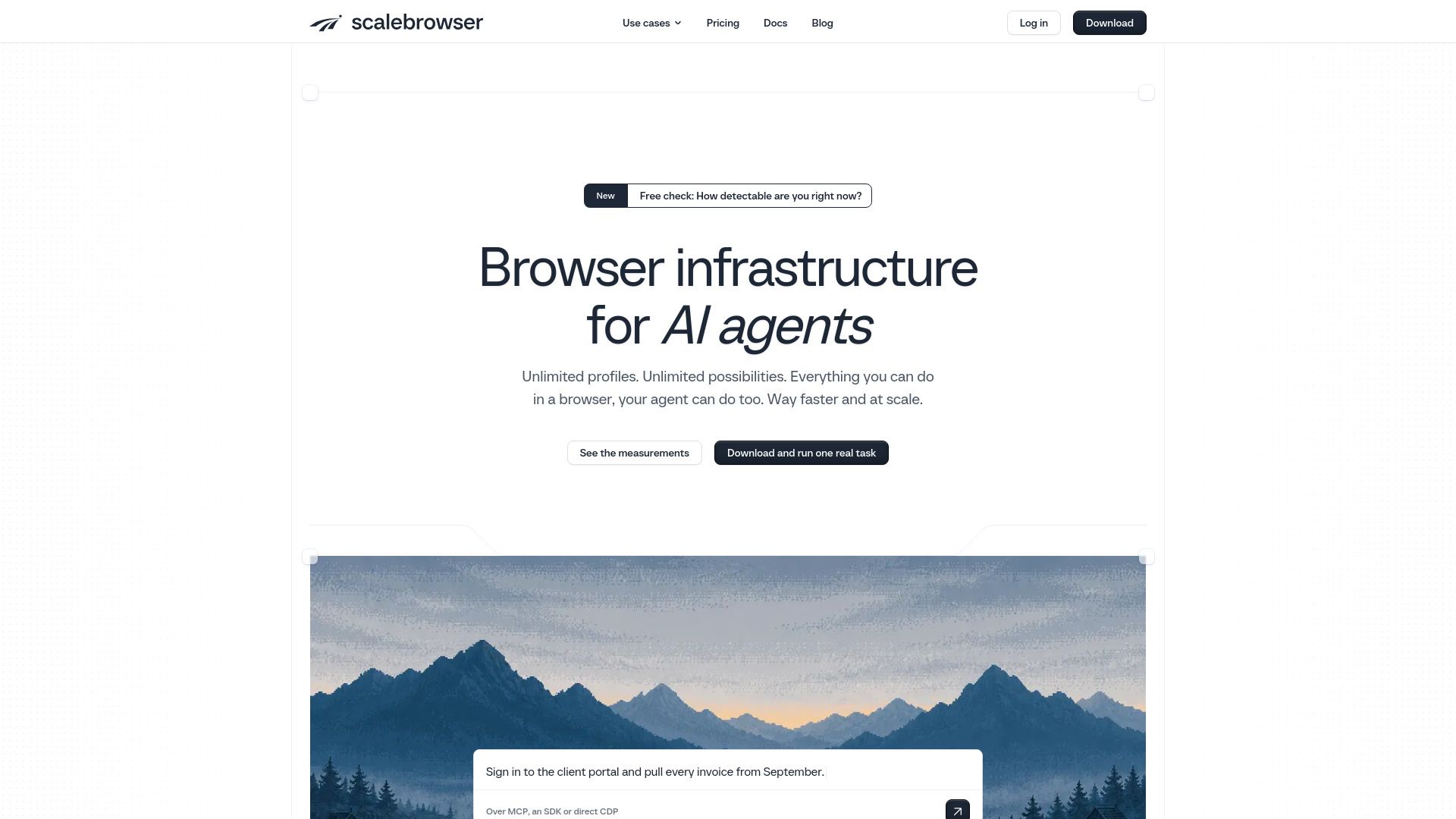
Give each agent its own isolated browser with a persistent identity. Stay signed in, handle the captcha, type like a human, and take over whenever you want.
- Monthly visits
- 18.8K
- Pricing
- Paid
- One browser, one machine, Solo, Studio
- Added
- 2026-09-21 18:12:37
About Scalebrowser
Scalebrowser provides self-hosted browser infrastructure for AI agents. It runs on users’ own machines, creating browser profiles that stay the same across restarts. Each profile has its own logins, cookies, and device identity, enabling agents to work as if they were a real, signed-in user. The system uses a dedicated Chromium fork built and signed by Scalebrowser and enforces human-like input through a dedicated layer. The daemon and the browser engine work together to ensure consistency, with updates that can be pinned or rolled back as needed.
Scalebrowser is designed for agents that must stay signed in and pass strict site checks without being tied to another agent on the same machine. It replaces cloud browsers by running on hardware controlled by the user. The tool ships in two parts: a daemon that manages profiles and interfaces, and a Chromium-based engine that runs the profiles. The daemon verifies engine signatures at install and launch, ensuring integrity before any profile starts.
The tool targets agents that need reliable identity and resilience across runs. It supports a workflow where an agent interacts with web content, responding to prompts and inputs through a human-input layer. The management interface and REST or MCP connections enable programmatic control, while the engine provides the browser environment in which profiles operate.
Scalebrowser emphasizes local control and security for AI agents. It provides four ways to communicate with the daemon and profiles, including MCP, Direct CDP, REST, or a management app. The system requires users to provide their own hardware, a real GPU, and a residential or mobile proxy, aligning with its self-hosted design and privacy posture. Documentation outlines install paths, profiles, and how to migrate existing code to Scalebrowser.
Use cases
- Run browsers for AI agents on your own machine, with a persistent identity per profile.
- Operate agents across multiple identities without shared data between profiles.
Key features
- Persistent identity per profile
- Isolated profiles per account
- Agent-visible signing-in flow
- Agent layer with token budget
- Captcha handling via human-like input
- Run trails with per-step results
- Stored logins and passkeys per profile
- Engine updates and version pinning
Pros and cons
Pros
Pricing
- Browsers at once 1
- Machines 1
- Unlimited profiles
- Persistent identity per profile
- Memory and tasks per profile
- MCP, both SDKs and direct CDP
- Stored logins, passkeys and cookies
- Inbox for email confirmation codes
- Human input and captcha handling
- Detailed trails with screenshots
- Create beautiful screen recordings
- Browser engine updates included
- Browsers at once 5
- Machines 1
- Unlimited profiles
- Persistent identity per profile
- Memory and tasks per profile
- MCP, both SDKs and direct CDP
- Stored logins, passkeys and cookies
- Inbox for email confirmation codes
- Human input and captcha handling
- Detailed trails with screenshots
- Create beautiful screen recordings
- Browser engine updates included
- Browsers at once 20
- Machines 3
- Unlimited profiles
- Persistent identity per profile
- Memory and tasks per profile
- MCP, both SDKs and direct CDP
- Stored logins, passkeys and cookies
- Inbox for email confirmation codes
- Human input and captcha handling
- Detailed trails with screenshots
- Create beautiful screen recordings
- Browser engine updates included
Reviews
Frequently asked questions
What is Scalebrowser?
Who is Scalebrowser for?
How can I access Scalebrowser programmatically?
What does the pricing cover?
Alternatives to Scalebrowser
More in AI Browsers
Adaptive Engine
Adaptive Engine evaluates, tunes, and serves LLMs for enterprise AI, using reinforcement learning to optimize models and production feedback.

Prompt Octopus
Prompt Octopus compares model responses side-by-side, with a VSCode extension and API key options for use in your codebase.

docbatch.ai
docbatch.ai extracts invoice, receipt, form and contract data from PDFs and images in batch, exporting to JSON, CSV or Excel.

CartAI
CartAI is an API that lets an AI agent search products, estimate cost and complete checkout and payment across merchants on a developer's behalf.