
- Monthly visits
- 77.7K
- Added
- 2026-08-06 17:55:55
About ego lite
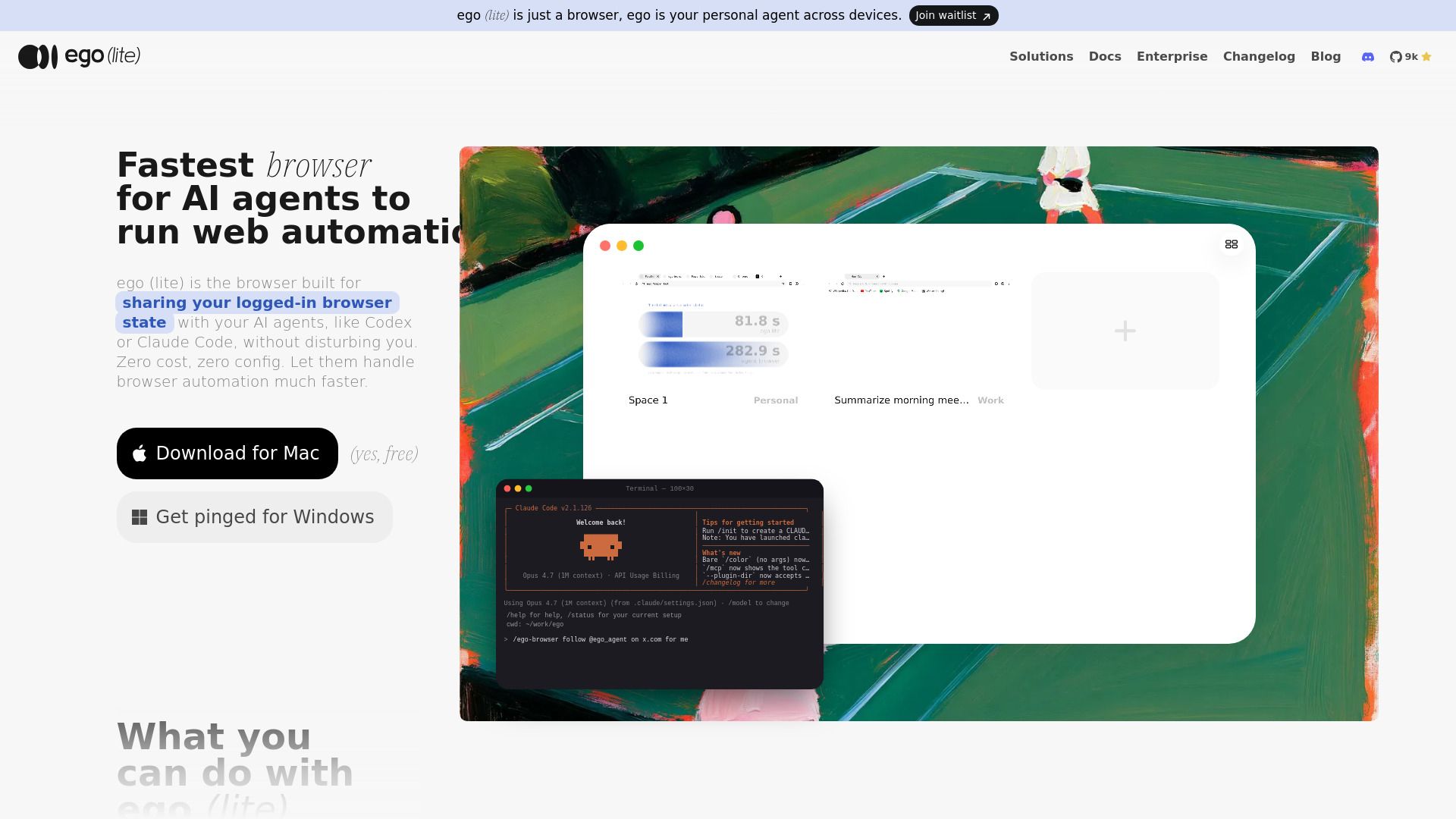
ego(lite) is an agent browser built to share with AI agents like Codex or Claude Code. It provides zero cost, zero config access to a real browser where agents can drive tasks without re-authenticating, using the same logged-in state as the user. Space creates an isolated workspace in which the agent can operate alongside human activity without disrupting tabs, windows, or sessions. The browser data remains under user control on the local machine, and the agent can access it through ego-browser to perform automations.
ego(lite) runs on Chromium and imports the user's Chrome setup in one click, preserving bookmarks, passwords, extensions, and login states. The agent operates in its own Space, separate from the user's tabs, and can reach into iframes, shadow DOM, and embedded widgets. Snapshots are built in a custom engine to reach parts of the page unreachable by plain fetch or injected scripts. This design aims to keep the user’s login state and data private and locally stored.
ego(lite) offers a set of capabilities for coding, sales, marketing, finance, legal, and research tasks by running automation directly in a logged-in browser. It supports parallel, multi-task operation in Spaces, and enables agents to read, fill, click, and navigate within the real browser with the user’s credentials. The tool emphasizes compatibility with a wide range of agent models and does not require an SDK for integration.
ego(lite) outlines plans and platform details including its browser-based approach, Space isolation, and compatibility with various agents. It notes that ego(lite) is built on Chromium, inherits the user’s existing Chrome data, and provides a space where tasks run without hijacking the user’s focus. The product highlights that there is an onboarding process to migrate data from Chrome and that the agent remains connected through ego-browser without needing a separate browser instance.
Use cases
- Research: scrape and aggregate social posts, returning a leaderboard and averages
- Career: find and apply to jobs automatically, stopping before submit for review
- Real estate: search and price home listings with mortgage estimates
- Travel: search and quote flight bookings, pre-filling passenger info
Key features
- Agent drives a real browser with logins and spaces
- Space provides isolated workspaces for agents
- Reaches inside complex page structures like iframes and shadow DOM
- Preserves user browser data locally
- No SDK required to connect agents to the browser
- Built on Chromium with real login state carried over
Reviews
Frequently asked questions
What is ego(lite)?
What is an agent browser?
Can ego(lite) replace Chrome as my main browser?
Can I bring Chrome bookmarks, passwords, and extensions into ego(lite)?
Alternatives to ego lite
More in AI Browsers
Adaptive Engine
Adaptive Engine evaluates, tunes, and serves LLMs for enterprise AI, using reinforcement learning to optimize models and production feedback.

Prompt Octopus
Prompt Octopus compares model responses side-by-side, with a VSCode extension and API key options for use in your codebase.

docbatch.ai
docbatch.ai extracts invoice, receipt, form and contract data from PDFs and images in batch, exporting to JSON, CSV or Excel.

CartAI
CartAI is an API that lets an AI agent search products, estimate cost and complete checkout and payment across merchants on a developer's behalf.