
- Pricing
- Freemium
- Free, Team, Business, Enterprise, Supporter License
About DevIntern
DevIntern is a self-hosted worker that turns ready Jira and Linear tickets into reviewable pull requests using the coding agent a team already has, running on its own infrastructure. It is built for teams already using Claude Code or Codex, including engineers, engineering managers, product managers and founders.
A daemon watches a team's ticket backlog, routes each ready ticket to the right repository, and runs the implementation loop locally in an isolated worktree. A feasibility gate checks a task for clarity before implementation, flagging vague specs back to the tracker with questions, and review comments on an opened pull request return to the same worker as commits on the same branch.
DevIntern supports Jira, Linear, Trello, Asana, Azure DevOps, GitHub Issues and plain markdown files as trackers, and works with Claude Code, Codex, Cursor or OpenCode as the coding agent, billed on the team's own model keys. An optional self-review loop lets the agent critique and fix its own diff before a human sees it, and a persistent queue with crash recovery and rate-limit detection keeps the worker running unattended.
Running DevIntern interactively from the terminal is free forever, with no account required. Continued unattended automation needs a license: a Team plan at $99 a month for up to 10 developers, a Business plan at $299 a month for up to 30 developers with priority support, a one-time $99 Supporter License for a single person's own repos, or an Enterprise plan reached by contacting sales for larger teams.
Use cases
- Keeping dependencies current and fixing production errors
- Running scheduled maintenance like weekly dependency updates and failing-main repair
- Turning a rough idea, log or Figma frame into a grounded ticket
- Inspecting the pipeline on one ticket before running the full worker
Key features
- Turns ready tickets into reviewable pull requests with your existing agent
- Manages the queue, checks, review feedback and recovery
- Routes tickets across multiple repositories from one worker
- Review comments return to the worker as commits on the same branch
- Feasibility gate flags vague specs instead of guessing
- Optional self-review loop where the agent critiques its own diff
- Persistent queue with crash recovery and rate-limit handling
- Works with Claude Code, Codex, Cursor or OpenCode on your own keys
- Supports Jira, Linear, Trello, Asana, Azure DevOps, GitHub Issues and markdown
- Source-available under the FSL, self-hostable
Pros and cons
Pros
Cons
Pricing
- Interactive use from your terminal, no time limit
- All trackers
- All coding agents, on your own keys
- Feasibility gate plus optional self-review loop
- No signup required
- Everything in Free
- Up to 10 developers
- Ready-ticket pickup and pull-request review handling
- Unlimited repos, no per-repo metering
- Email support
- Everything in Team
- Up to 30 developers
- Priority support
- More than 30 developers
- procurement and invoicing
- security questionnaires
- custom terms
- Solo automation for one named person's own repos
Reviews
Frequently asked questions
Why not just give my coding agent a tracker connection myself?
Is agent-written code good enough to merge?
Do you want my tracker token and push access?
What if DevIntern disappears?
Do we have to change our workflow?
Which trackers, agents, and models are supported?
Alternatives to DevIntern
More in AI DevOps Assistant
Bitbucket
Bitbucket is a code hosting and CI/CD platform with AI-enhanced workflows, integrated with Jira, for software delivery.
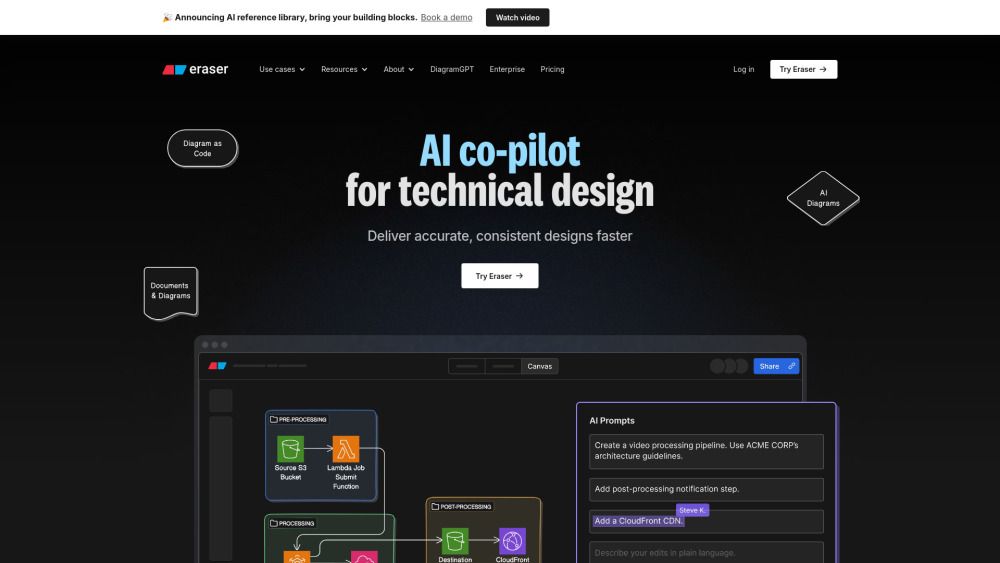
Eraser
Eraser is a versatile diagramming tool designed for engineering teams, enabling real-time collaboration on documents and diagrams such as architecture diagrams, design docs, and flowcharts. Its seamless integrations with platforms like GitHub, Notion, and Confluence enhance productivity, while features like markdown support and version history ensure data portability and safety. With a user-friendly interface that minimizes distractions, Eraser allows teams to maintain focus and streamline their

Coder
Coder provides self-hosted AI development infrastructure with governance for enterprises.

QA.tech
QA.tech provides autonomous AI QA agents to test web and mobile apps on PRs and in CI/CD, using plain-language goals without scripts.

CloudKeeper Tuner
CloudKeeper Tuner is an automated AWS usage optimization platform delivering real-time recommendations across AWS services for engineering teams.

Project Mela
AI platform for collaboration on tech projects, streamlining management.