
- Monthly visits
- 18.2K
- Pricing
- Freemium
- Hobby
- Company
- Cerebrium, Inc.
- Added
- Jan 07 2025
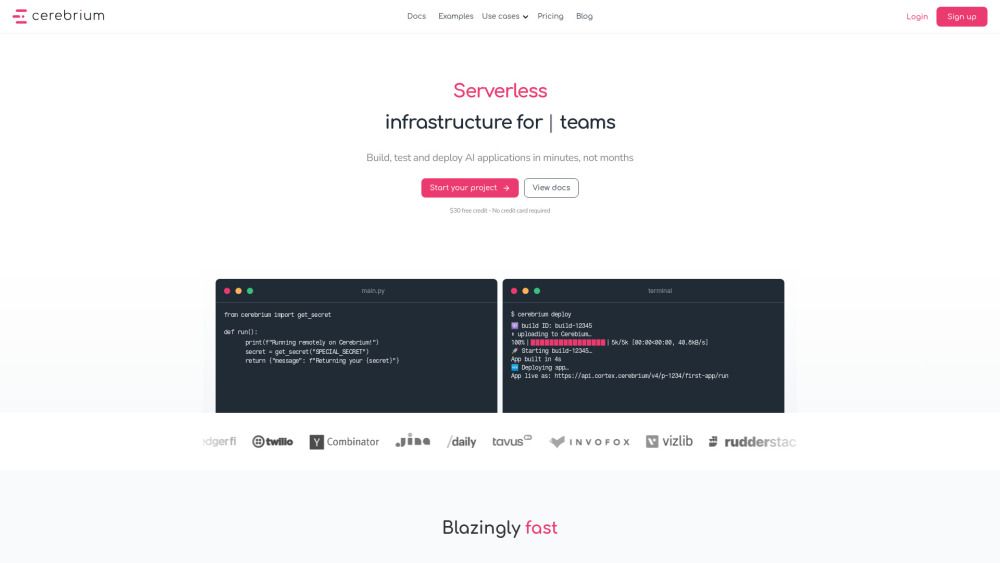
About Cerebrium
Cerebrium builds serverless GPU infrastructure for real-time AI workloads. It is designed for teams deploying voice agents, video models, LLMs, and other AI workloads with sub-second cold starts and instant autoscaling. The platform abstracts away cold starts, autoscaling, orchestration, observability, and regional deployment so engineers can focus on building. It supports LLMs across regions with data residency in mind and scales at speed, without needing to manage servers.
Cerebrium emphasizes reliable production-grade performance by enabling containers to launch in seconds and scale automatically in response to bursts. It highlights low-latency operations from the first request and offers full observability with logs, metrics, and system performance alongside OpenTelemetry integration. The architecture is designed to run workloads across multiple clouds and regions with instant access to GPUs.
The tool supports a range of workloads including voice, LLMs, image and video workloads, and embedding/reranking services. It provides WebSocket endpoints, REST API endpoints, and support for private Docker images, CI/CD, and gradual rollouts. It also lists multiple GPU types, multi-region deployments, and concurrency/batching capabilities as core features.
It mentions data residency options, gVisor-based isolation, and 99.999% uptime with multi-region failovers. It outlines plans and integrations across regions and cloud providers to enable scalable, compliant AI workloads.
Use cases
- Real-time AI workloads including voice, LLMs, and other AI pipelines.
Key features
- WebSocket endpoints
- OpenTelemetry Integration
- Using Private Docker Images
- Concurrency & Batching
- Asynchronous jobs
- Distributed storage
- Multi-region deployments
- Streaming endpoints
- REST API endpoints
- Custom Dockerfiles
- CI/CD & gradual rollouts
- Secrets management
Pros and cons
Pros
Cons
Pricing
- Compute / month
- 3 user seats
- Up to 3 deployed apps
- 500 containers + 5 Concurrent GPUs
- Stack & intercom support
- 1 day log retention