
About AudioLDM
AudioLDM is a text-to-audio generation model developed by researchers at the CVSSP centre of the University of Surrey and the Department of EEE at Imperial College London. It turns written descriptions into sound effects, human speech and music, and it can also edit existing audio through text, with zero-shot style transfer, inpainting and super-resolution. The project offers a paper on arXiv, code on GitHub and a Hugging Face Space demo.
AudioLDM builds on contrastive language-audio pretraining (CLAP). Latent diffusion models are trained on audio embeddings in a continuous space learned by a VAE, and at sampling time a text embedding serves as the condition. Because the model learns audio representations without modelling the cross-modal relationship, it can be trained on AudioCaps with a single GPU and without text supervision, which the authors credit for its generation quality and computational efficiency.
AudioLDM's demonstrations show control over the acoustic environment, the material of a space, pitch and temporal order through the prompt, for example a man speaking in a huge room versus a studio. AudioLDM also supports label-to-audio and unconditional generation, accepts prompts written by ChatGPT, and performs zero-shot audio manipulation: changing the style of a clip, filling in missing sections with inpainting, and restoring detail through super-resolution.
AudioLDM is published as a research project rather than a commercial service and has no stated price. The authors share their model evaluation code on GitHub with the aim of making audio generation models easier to compare. They are confirming a data-related copyright issue, and the pretrained models are to be released once that check is complete.
Use cases
- Synthesizing general audio and sound effects from text descriptions
- Generating ambient or other music from a written prompt
- Changing the style of an existing audio clip with a text prompt
- Filling in missing parts of a recording through audio inpainting
- Restoring detail in low-resolution audio
- Benchmarking and comparing audio generation models
Key features
- Text-conditional generation of sound effects, human speech and music
- Zero-shot text-guided style transfer, inpainting and super-resolution
- Latent space built on CLAP audio representations
- Trainable on a single GPU without text supervision
- Prompt control over room material, acoustic environment and pitch
- Label-to-audio and unconditional generation
- Works with prompts written by ChatGPT
- Open evaluation code for comparing audio generation models
- Paper, GitHub code and a Hugging Face Space demo
Pros and cons
Pros
Cons
Reviews
Alternatives to AudioLDM
More in AI Image Segmentation
PixExtender
PixExtender is an AI image extender that expands images to exact sizes and aspect ratios, online, with free credits to start.

AudioCraft
AudioCraft is a PyTorch library for deep learning research on audio generation, with models like MusicGen and AudioGen and an EnCodec-based codec.
CogVideoX
CogVideoX is an open-source text-to-video and image-to-video generation model with quantized inference for GPUs of varying sizes.

Tancky AI
Tancky AI is an online AI image combiner and photo merger that merges up to 4 images into a single photorealistic scene with commercial rights.

Image2Layer
Image2Layer separates a flat image into editable layers (up to 10) and exports layered PSD, PNGs, or ZIP packages for Photoshop and other tools.
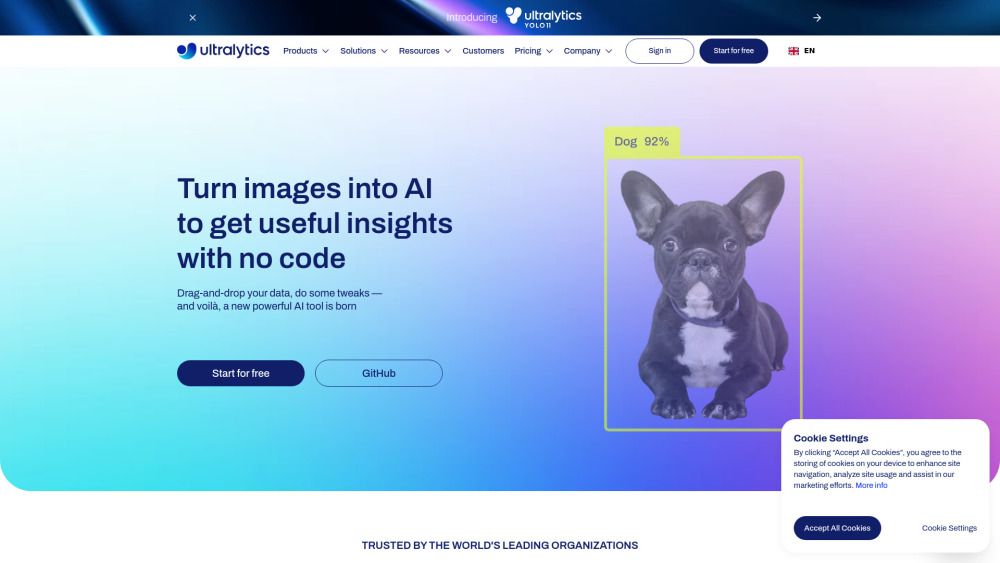
Ultralytics
Ultralytics is a leading provider of AI and machine learning solutions, specializing in open-source software development. Their flagship product, Ultralytics YOLO, offers advanced capabilities for real-time object detection, empowering users to harness the power of AI with ease. With a strong commitment to data privacy, Ultralytics ensures that users retain full ownership of their data, securely hosted on trusted platforms like Google Cloud and Amazon AWS.