
- Pricing
- Freemium
- Starter, Creator, Studio
About Image2Layer
Image2Layer is an online tool that converts a single image into editable layers for design and production workflows. It targets creatives such as designers, marketers, animators, and game artists who need modular assets and quicker iteration without manual masking.
The tool works by uploading a JPG, PNG, or WebP image (up to 24 MB) and running an AI-based separation that yields up to 10 layers, including subjects, objects, text-like graphics, shadows, and backgrounds. The process emphasizes rebuilding hidden background areas for edits.
Results are exportable as layered PSD files, transparent PNGs, or ZIP packages, enabling immediate use in Photoshop, Photopea, GIMP, Affinity Photo, or Krita. The workflow is designed to fit production-ready assets within typical creative pipelines.
Image2Layer emphasizes a background reconstruction approach, where hidden areas behind foreground elements are rebuilt to avoid holes, allowing edits without redoing masking manually.
Use cases
- Prepare assets for design revisions, product marketing, animation, game scenes, and client handoff.
Key features
- Semantic Layer Separation
- Background Reconstruction
- PSD & PNG Layer Export
- Designed for Production Work
- Free Tools in Browser
Pros and cons
Pros
Pricing
- 1,000 credits a month
- About 125 layers a month
- Export layered PSD, transparent PNG and ZIP
- Priority generation
- Results kept in My results for 30 days
- No watermark, commercial use on every plan
- 2,400 credits a month
- About 300 layers a month
- Priority generation
- Results kept in My results for 30 days
- No watermark, commercial use on every plan
- 6,400 credits a month
- About 800 layers a month
- Fastest priority generation
- Early API access option
- Results kept in My results for 30 days
- No watermark, commercial use on every plan
Reviews
Frequently asked questions
Can I export image to layers results as a PSD file?
What image formats work with image to layers conversion?
Alternatives to Image2Layer
More in AI Image Segmentation
PixExtender
PixExtender is an AI image extender that expands images to exact sizes and aspect ratios, online, with free credits to start.

AudioCraft
AudioCraft is a PyTorch library for deep learning research on audio generation, with models like MusicGen and AudioGen and an EnCodec-based codec.

Tancky AI
Tancky AI is an online AI image combiner and photo merger that merges up to 4 images into a single photorealistic scene with commercial rights.
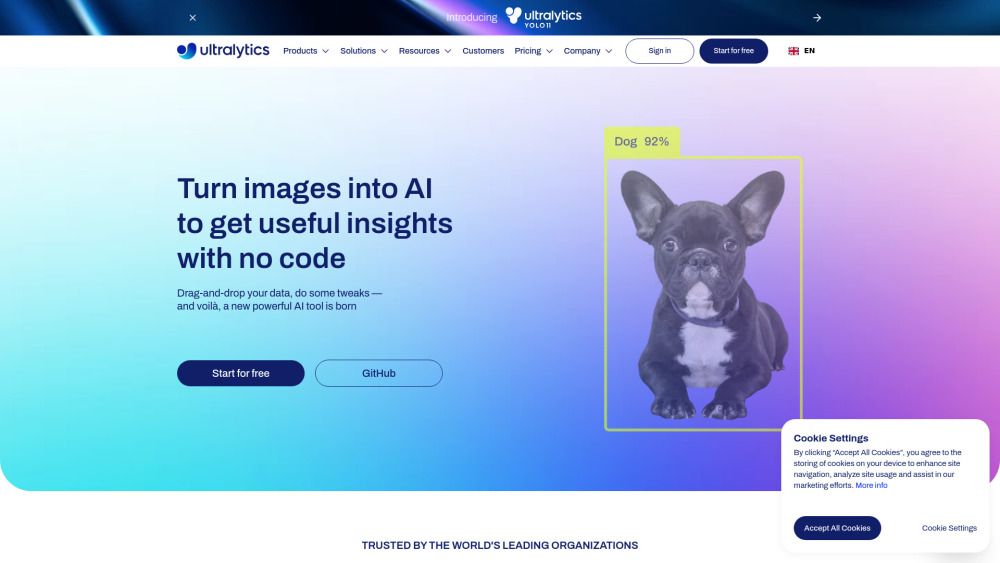
Ultralytics
Ultralytics is a leading provider of AI and machine learning solutions, specializing in open-source software development. Their flagship product, Ultralytics YOLO, offers advanced capabilities for real-time object detection, empowering users to harness the power of AI with ease. With a strong commitment to data privacy, Ultralytics ensures that users retain full ownership of their data, securely hosted on trusted platforms like Google Cloud and Amazon AWS.

FaceSymAI
FaceSymAI analyzes facial symmetry from a single photo in a browser, using 68 landmarks and 7 feature pairs.
Viso Now
Build any real-world vision app in minutes. From idea to live vision app, in three steps. Start with an idea. Type it in plain language or drop in a clip. No datasets, no labelling, no model selection, just say what to watch for. Then watch it build itself. Viso Now connects the feed, recognizes the scene, writes the detection logic and wires the alerts, all agentic, on auto-pilot, in front of you. Then simply refine and ship live. You can tune any rule, threshold or output, then publish. Your vision app runs live and pushes events wherever your team already works.