- Monthly visits
- 249.7K
- Company
- Anima
- Added
- Apr 16 2025
About Anima
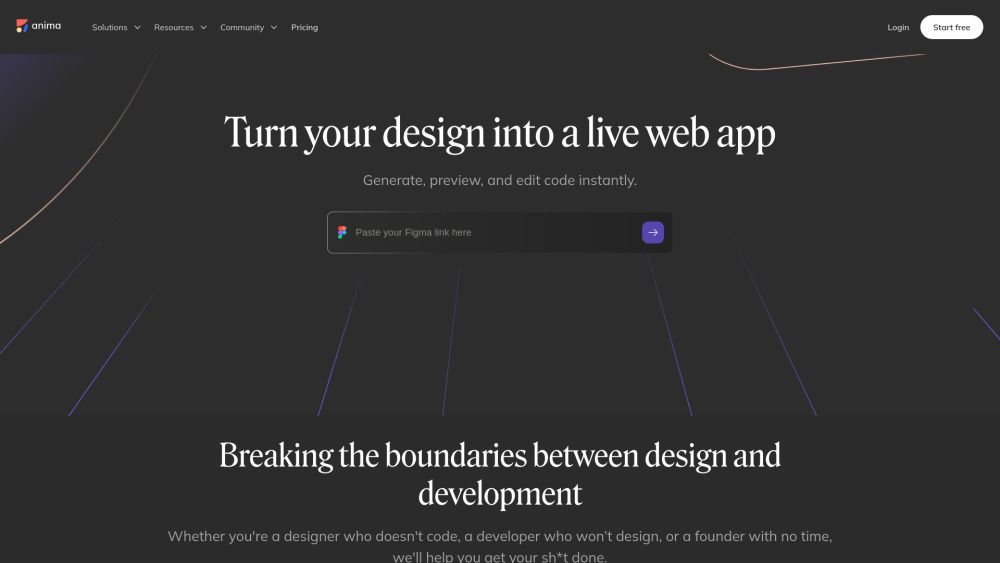
Anima acts as a design intelligence layer that converts visual intent into working software. It supports production-ready outputs generated from Figma designs, live URLs, or prompts, enabling product teams to build directly or integrate via API. The tool emphasizes collaboration between humans and AI agents to turn design into code across workflows and platforms.
Anima provides a workflow that starts from a prompt, a Figma design, or a live site and outputs runnable HTML or React code. It preserves structure, assets, and visual details, allowing iterative refinement and export or handoff as needed. It also supports importing artifacts and code from other AI tools and running them as live apps for ongoing development.
Anima offers options to output code for different stacks, including HTML with CSS, Tailwind, or inline styles, and React with TypeScript or JavaScript. It enables adding databases, authentication, version restoring, publishing, exporting, and handoff, all within a browser-based environment that keeps the build context in sync with the design context.
Anima outlines plans and integrations involving MCP, Figma, and API access. It includes an Anima MCP for agent integrations, an Anima API for automating code generation, and mentions platform compatibility with Bolt.new and Replit, plus enterprise options and design-system workflows.
Use cases
- Convert Figma designs to production-ready HTML/React code
- Import and run artifacts or code from other AI tools
Key features
- Import Figma designs and turn them into live HTML/React code
- Clone websites or import pages for building in one app
- Build with on-brand design systems and assets
- Output code for multiple stacks (HTML, React)
- Anima MCP to integrate AI agents