- Monthly visits
- 8.2K
- Pricing
- Paid
- Text-to-motion (version 1.0), Text-to-motion (version 2.0), Text-to-motion (version 3.0), Video-to-motion (version 2.0), Video-to-motion (version 2.1), Locomotion, Stitching and looping, Auto-rigging, Character generation
- Company
- Uthana, Inc.
- Added
- Mar 18 2025
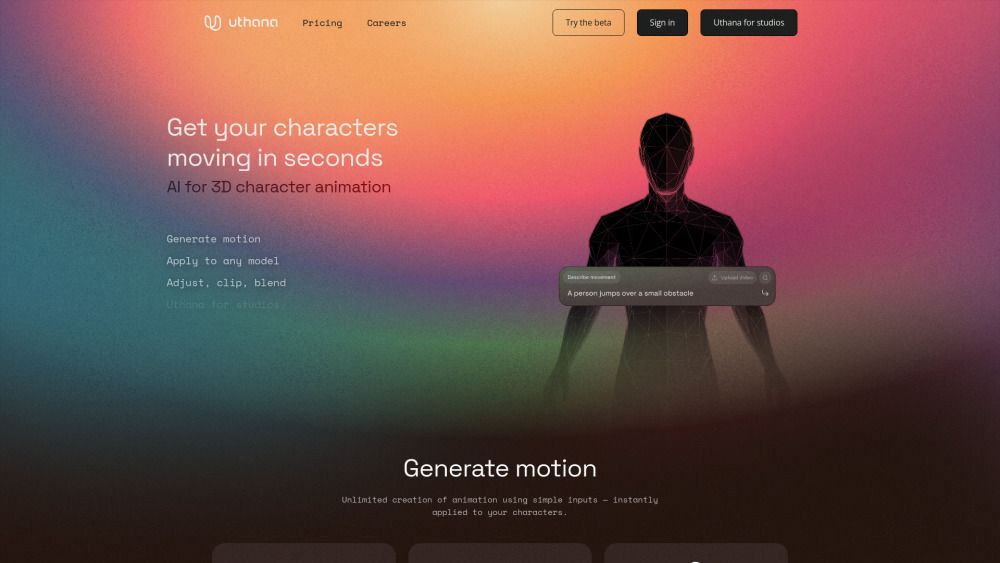
About Uthana
Uthana builds models that create motion, data that trains motion systems, and embodiment technology that transfers movement across characters and robots. Human motion is a missing layer in embodied AI. A character or robot needs more than geometry and appearance. It needs movement that reflects intent, responds to control, and fits the body performing it.
Uthana began in games and 3D production, where motion has to work on real characters, inside real tools, under production constraints. That required more than a model demo. It required retargeting across custom rigs, editable keyframes, standard file formats, APIs, and outputs that studios could continue refining. Physical AI extends the same underlying problem. The target body changes, but the need for structured motion, reliable transfer, and usable outputs remains.
We treat motion as one system from source to embodiment. Model output is not finished until it can be inspected, retargeted, exported, or delivered in the representation the next system expects. We separate demonstrated capability from roadmap. Technical specifications, validation criteria, and unresolved constraints are defined before an enterprise engagement scales. The goal is not a broad claim about intelligence. It is motion that works in the customer's pipeline.
Use cases
- Robot training: turn human motion into robot-ready data
- World models: add structured 3D movement and action labels
- Game studios: production-ready character animation
Key features
- Video-to-motion: generate motion from video
- Locomotion: generate responsive movement
- Auto-rigging: rig unrigged characters automatically
- Motion retargeting: transfer motion across bodies
Pros and cons
Cons
Pricing
- Text-to-motion 1.0
- -
- Text-to-motion 2.0
- Text-to-motion 3.0
- Video-to-motion 2.0
- Video-to-motion 2.1
- Locomotion 1.0
- Stitching and looping 2.0
- Auto-rigging
- Character generation